

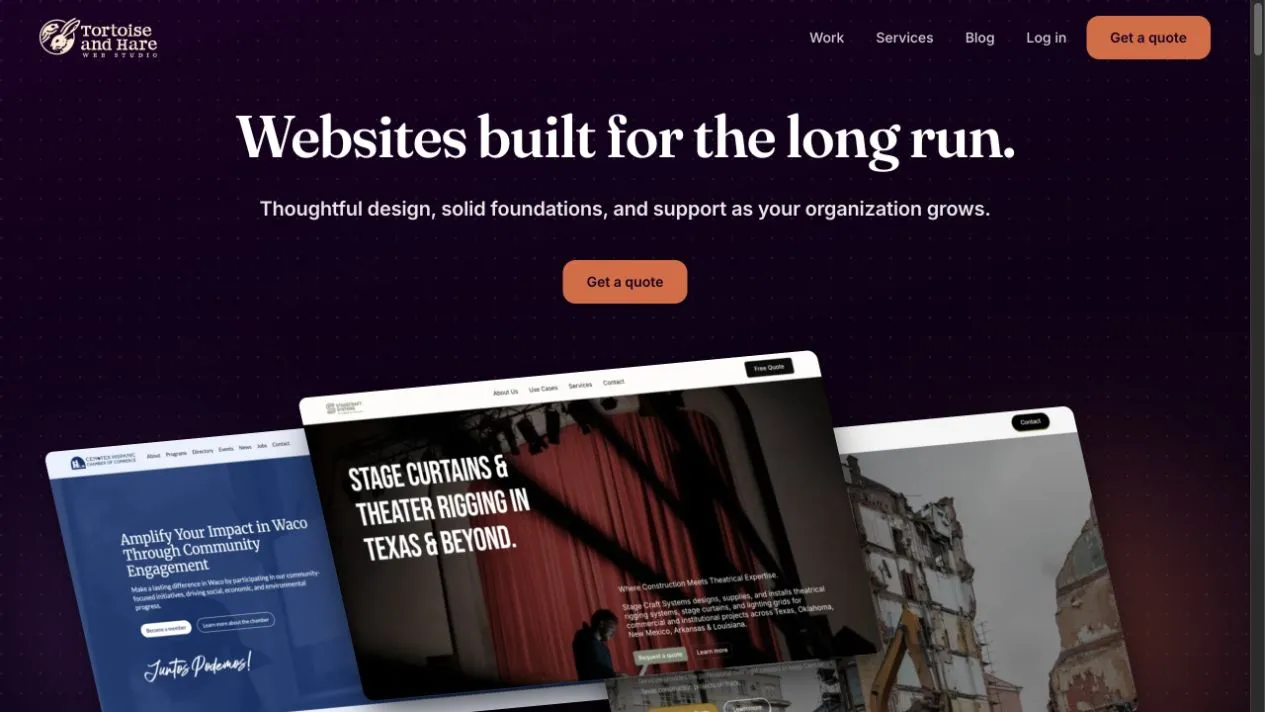
Most business owners do not need to care which framework powers their website. They need the site to explain the business, earn trust, show up in search, and bring the right people to the next step.
We do need to care. The system underneath the page determines how much control we have over its structure, how safely we can change it, and how much technical baggage every visitor has to download.
Our short answer
Astro gives us tighter control over the technical foundation without asking the client to become the web developer.
First: Astro is not a drag-and-drop website builder
Astro is a web framework for content-driven websites. It does not arrive with a visual page editor or a built-in content management system. A developer builds the public website in Astro, then connects the editing, forms, analytics, hosting, and publishing tools the project actually needs.
That sounds less convenient than an all-in-one builder, and for some teams it is. If you want to move sections around yourself, install a plugin, and manage the site without a technical partner, WordPress, Webflow, Wix, or another visual system may be the better fit.
We choose Astro when the job calls for a fast, tailored public site with a controlled content workflow. The owner does not have to become the web developer. We take responsibility for the system around the framework.
The SEO value is control, not a ranking trick
Astro's components render to HTML without adding browser JavaScript by default. Interactive pieces can be added only where they are needed. That is the core of Astro's islands architecture.
For our work, the more important benefit is that the technical SEO foundation becomes explicit and testable:
- Every important page can render complete, readable HTML.
- Titles, descriptions, canonical URLs, and social metadata live in a shared system.
- Structured data can match the content people actually see.
- Redirects can be checked before a migration goes live.
- Image dimensions and responsive files can be built into the page.
- The sitemap can be generated from the real route inventory and checked during every release.
Astro's official sitemap integration can generate the XML route list during a build. We add another gate: our release checks compare that sitemap with the canonical, indexable pages that were actually rendered. A green build should mean more than “the code compiled.”
Our own migration gave us a useful first measurement
We moved the Tortoise & Hare site to Astro on September 9, 2026. The launch preserved 59 indexable routes, including 19 English articles, 12 reviewed translations, and 16 case studies. We also verified 15 studio redirects so older links had a deliberate destination.
Then we compared two equal, complete 17-day Search Console windows.
Two equal 17-day periods
The early change was more visibility and more clicks.
+118%
Search impressions
1,269 before · 2,771 after
5×
Search clicks
3 before · 15 after
+125%
Click-through rate
0.24% before · 0.54% after
Before migration
August 24 to September 9- Impressions
- 1,269
- Clicks
- 3
- CTR
- 0.24%
- Average position
- 21.6
After migration
September 10 to September 26- Impressions
- 2,771
- Clicks
- 15
- CTR
- 0.54%
- Average position
- 24.2
Average position moved lower. The honest reading is broader discovery, not a universal ranking lift.
This is encouraging, but it is not a clean experiment. We changed the framework, restored articles, added reviewed translations, preserved redirects, and expanded the route set together. Search Console also reports appearances and clicks, not unique people or leads. We cannot isolate Astro as the cause.
What we can say is that the migration did not require sacrificing the existing content library to get a new technical foundation. The new site was discoverable, the old paths had a plan, and the early complete-period numbers moved in the right direction.
Sison Tacos: a small local site with a clear search job
Sison Tacos does not need hundreds of pages. It needs people to find the restaurant, understand what it serves, view the menu, plan a visit, and ask about catering.
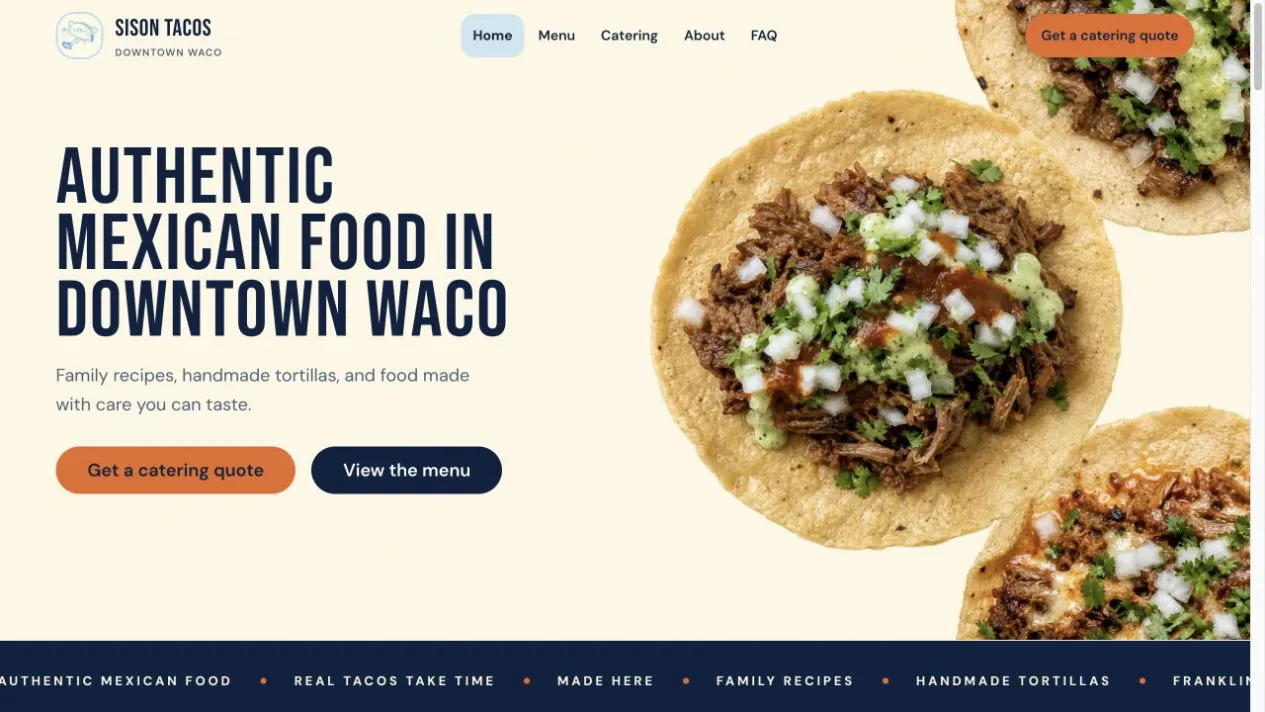
First complete post-launch period
Existing demand found a clearer path to the restaurant.
September 12 to September 26 · 805 impressions- Click-through rate
- 10.1%
- Search clicks
- 81
- Average position
- 4.0
How to read the result: branded demand drove most of the activity.
- 50 clicks came from the branded query “sison tacos.”
- 6 clicks came from “sison tacos menu.”
- The homepage received 80 of the property's 81 clicks.
- Menu, About, Catering, and FAQ pages had already begun appearing in the report.
This is not proof that Astro created demand for the restaurant. It is proof that a new site can launch with a clean set of useful destinations and meet existing branded demand without hiding the business behind a client-side application.
Dani Sells Texas: build the search structure before the cutover
The current Dani Sells Texas preview uses Astro for a different problem. Real estate content needs localized service pages, bilingual paths, article templates, structured data, and careful language connections.

The preview currently produces 22 English and Spanish sitemap URLs. Its pages render canonical tags, language alternatives, and structured data from the same route-aware system. The site can validate the whole public search structure before anyone points the main domain at it.
That matters because migration mistakes are usually boring and costly: a translated page points to the wrong canonical, an old article loses its destination, a sample listing gets indexed as if it were live inventory, or a sitemap quietly omits half the site. Astro does not prevent those mistakes by itself. A testable build process makes them easier to catch.
What Astro does not solve
A technically clean site can still fail. Astro does not give you:
- A clear offer or a reason for someone to choose the business
- Useful local information, original expertise, or good writing
- Reviews, links, citations, or other signs of authority
- A publishing plan that keeps the site current
- A measurement process that turns search data into decisions
Google's results do not award points because a source file ends in
.astro. The framework is valuable when it helps a team ship
accurate, accessible, maintainable pages consistently.
Who should consider an Astro website?
A strong fit
A content-driven business or organization that wants a tailored design, a lean public site, and a technical partner responsible for the system around it.
Possible with the right CMS
A marketing team that publishes often but wants editors separated from the public website code. The editing workflow matters as much as the framework.
Probably not the first choice
A team that wants a familiar visual builder, a large plugin library, or complete in-house control without a developer. An integrated CMS may be the safer operating model.
The framework is only one layer of the website
We are using Astro because it fits how we want to work: deliberate structure, less browser overhead by default, visible content, and release checks that make SEO details harder to lose.
The client experience should still feel simple. Tortoise & Hare handles the framework, hosting, analytics, Search Console, publishing system, and agreed improvements. The business owner should be able to focus on the business and make informed decisions about the website.
Read how our managed website process works, review the Managed Websites offer, or see our custom web development work if your project needs more than the standard plan.
If search is the immediate problem, start with our SEO and AEO service. A framework can support the work, but the strategy still has to come first.
Get a quote when you are ready to talk through the fit.